 The Internet Society (ISOC) is a nongovernmental international membership society. It promotes the orderly use and development of the Internet. The Internet Architecture board is a committee within the ISOC that makes important policy decisions about operations and future developments. “Its members are, for the most part, employees of large corporations (such as Microsoft) that have important financial stakes in the Internet” (281). The Internet Engineering Task Force (IETF) oversees technical matters. All these forces and boards are responsible for what happens on the internet.
Sunday, October 31, 2010
ISOC, see?
The Internet Society (ISOC) is a nongovernmental international membership society. It promotes the orderly use and development of the Internet. The Internet Architecture board is a committee within the ISOC that makes important policy decisions about operations and future developments. “Its members are, for the most part, employees of large corporations (such as Microsoft) that have important financial stakes in the Internet” (281). The Internet Engineering Task Force (IETF) oversees technical matters. All these forces and boards are responsible for what happens on the internet.

Service vs. Content
 “Internet service providers (ISPs) connect users to the Internet and provide email accounts. Telecommunications giants AT&T, cable TV giant Comcast, and AOL (now subsidiary of TimeWarner) are the industry leaders and account for nearly half of all U.S. Internet subscriptions among them” (281). Internet service providers differ from content providers. Content providers are mainly designers. They provide the layout and design of Web pages, and opposed to providing the service such as email and communications. Content providers – web designers – have popped up all over. You can do this service remotely, which is pretty awesome. There is no specific reason for a web designer to be in the same room as the owner.
Robbing the Web
 Leading software and hardware providers include Apple, Microsoft, etc. Similar to John D. Rockefeller and other Industrial Age “robber barons” Bill Gates’ the owner of software giant Microsoft was found guilty of monopolistic practices. Microsoft Corporation “was forced to change its business practices by unbundling its browser and media player from the Windows operating system” (291). That is very interesting, because as a Windows user, I am still a user of Windows media player and Internet Explorer. But since this finding, Bill Gates has been able to change is image from “robber baron” to global philanthropists. Copyright laws and patents have changed the way that people react to the web.
Design the Web
 Media design is the key to a “good” webpage – not the amount of time a user spends on the page. That would reflect thinking of the “old media.” They believed that they needed to deliver people for the advertisers. “From the perspective, the key to having a good Web page is lots of empty dark space (or blank white space or gray space) with small print, intriguing Flash animations, and large graphic design space” (290). I think this is very intriguing because earlier I mentioned the Cannes Lion Web page being poorly designed. They used way too much color and your eye moved from one side of the page to another trying to find a place to land. A good example of a well designed page is Apple’s home page. Your eye is immediately drawn to the logo and what they are selling - their graphic design.
Sticky Web
 The major types of content on the web include electronic publishing, entertainment, online games, portals, and search engines.
Electronic publishing includes formal “old media” such as news papers and magazines – this includes the extremely popular New York Times.
Entertainment also includes “old media” such as music, television and movie. For while people were illegally file sharing for free; larger entertainment companies have responded with charged responses. Hulu, also for example, showed their (NBC Universal, Fox, etc.) large hits with limited commercials on the web.
Online Games includes MUDs and MMOs. MUDs are Multi-User Dungeons; they evolved from text-based fantasy games to multi-user graphical interfaces. Sorcery and fantasy games are most popular. In addition to MUDs, there are also variations on classic card and board games and puzzle games.
Portals combine directories, interpersonal communication, and information into an all-purpose, customizable “launch pad,” This will be used when visitors go on the Internet. Leading portals include Yahoo!, AOL and MSN. Now portals include social networking.
Search engines are equally as important as the other four. This category includes Google, ProQuest, YouTube, etc.
Monday, October 25, 2010
Advertising Promotes Society
 One of the great things that that advertising does for me and society is that it communicates a brief message. It allows for me and other members of society to briefly watch a commercial or look at an image and immediately get the message. If an advertiser is good, you do not have to think to hard about the message it is portraying.
Websites can also be advertisements; much more in-depth ones. Like I mentioned with the Cannes Lions website – it is really not appealing to the eye, nor is it up to date. Sites like MediaBistro.com are consistently updated and allow for users to log in and use their resources for their own personal gain. The site is clear and straight forward.

Advertising also creates jobs. In order for there to be ads, there needs to be a team of people involved in creating it. From marketing to research, the team is a key essential to why advertising it good for society.
Also, in some cases, advertising is socially responsible. On the Ad Week post, I discussed how the site challenged six companies to fight cyberbulling. Their ads will hopefully make a difference, no matter how small it may be.
Also political advertisements notify people of what they need to know in order to make an informed decision.
Advertisements must be pleasing to the eye, no matter what type of media they are.
As you can see, advertisements are a key essential to our lives and create a unified message across the spectrum.
Sunday, October 24, 2010
Ad(d) a Week
Ad Week is a site for advertising news and analysis. After scoping around the site I can tell that the writers are strong bloggers – they understand that they need a style that is relevant and constant – and very smart people.
One of the articles is entitled Bully Pulpit: Shops Battle Cyberbulling Teen-targeted campaigns aim to silence the crescendo of abuse. It explains that our lives are shifting to online lifestyles but we are still dealing with real world problems – thus bullying. One of the most current examples is the bulling of Rutgers student Tyler Clementi who had such a difficult time dealing with the bulling, he committed suicide. The fact that there is a Cyberbullying Research Center shows that this is truly a mass problem that has not just begun and is not going away. Ad Week challenged six companies to start campaigns to fight cyberbullying. These companies are Arnold, Colossal Squid, Cramer-Krasselt, Fathom, Globalhue and Pereira & O’Dell. One can only hope that they succeed in their endeavors.
One of the articles is entitled Bully Pulpit:
 Shops Battle Cyberbulling Teen-targeted campaigns aim to silence the crescendo of abuse. It explains that our lives are shifting to online lifestyles but we are still dealing with real world problems – thus bullying. One of the most current examples is the bulling of Rutgers student Tyler Clementi who had such a difficult time dealing with the bulling, he committed suicide. The fact that there is a Cyberbullying Research Center shows that this is truly a mass problem that has not just begun and is not going away. Ad Week challenged six companies to start campaigns to fight cyberbullying. These companies are Arnold, Colossal Squid, Cramer-Krasselt, Fathom, Globalhue and Pereira & O’Dell. One can only hope that they succeed in their endeavors.
Saturday, October 23, 2010
Eating at the Media Bistro
 MediaBistro.com is a great site to find a job in the media business. It also advertises However it also links to brief blog posts that share about media influences. I personally am a member of the site – looking for a job!
One of the articles on the site explains how Amanda Hesser, former food editor of New York Times Magazine used a social media site – Food52 – to create a cookbook to be released in 2011. This idea is called crowdsourcing. Her co-editor is Merrill Stubbs, a freelance writer. The duo also used social media sites like Twitter and Facebook to collect the best homemade recipes.
Another article shares how one can use the social media site LinkedIn.com to create connections and hopefully job opportunities. The article opens by asking when was the last time you updated your LinkedIn page. “Most job seekers have been told the benefits of LinkedIn. More than just Twitter on Ritalin or Facebook without Farmville, the social network is an invaluable tool for researching companies, networking, and discovering new opportunities.” It is so key to finding a job; despite that, buyer beware. One of the commenters shared examples of how he or she was scammed in the past short period of time.
Can(nes) you fight Lions?

Cannes Lions is an international advertising festival. The site is flashy, and distracting. The color scheme is yellow-green-blue; absolutely not my first choice. There appears to be no articles, but rather just a plethora of videos. The site is primarily European; if you want to register for a class you must pay is Euros. The classes appear to be huge. The Essential Information page also has not been updated since at least July. It is hard to fathom that a site a international renowned as Cannes Lions would allow this to fall to the way side.
Saturday, October 2, 2010
Lone Star Alaska
New Season Brings Strong Ratings - for Most
I can not comment much on Lone Star, but I must say FOX must not have been predicting good results for it if they were to cut hit such as House short just to drag in viewers. When DVRs were first becoming popular and, like FOX, NBC was sneaky about it’s show time and ran the Friends finale over by, I believe, five minutes. Because this was not scheduled programming it was not recorded and many fans missed the first airing of it.
 Sneakiness does not gain viewers, it tends to put a sour taste is people’s mouth.
I was also thinking about Dancing With The Stars. First of all – season eleven? I remember when this show premiered as a late summer hit. And a soap star won! This season will be interesting, though. I have heard of, for the first time, every contestant except one – I am embarrassed to admit which one. He/She may be terribly popular.
I think Dancing With The Stars is trying to appeal to a younger audience, and it is working; however, why is Bristol Palin on this show? I think the nation would rather see her mother make a fool of herself, oh wait. . . But really, similar to Kate Gosselin, should she not be at home caring as a mother. Please do not misread this, I am all for working mothers, but when you have the money that these women already have do you really need to hop onto the reality show bandwagon? I truly believe not.
Television Surfs Fast-Forward
 If the conventional TV model is dying, I think that the internet is going to replace it. The computer has become a one-stop shop for all types of things. You can communicate on sites like Facebook and Skype. You can journal/scrapbook on sites like Blogspot and Tumblr. Now you can watch television shows on the networks' websites. A prime example of this, which is explained in the textbook, is that The Office can document that one-fifth of their viewers watch the show online. Speaking directly to this, I have never seen a new episode on the television, but I have watched seasons one through three, and season five. The computer – the internet – is what will take over. Advertisers can also control that a viewer sit for thirty seconds and watch their ad. So although consumers are not additionally paying for the product, the way they pay for cable television, they are still receiving a service they would have paid a lot of money for otherwise. Also for clarification, it is realized that you pay for the internet, but as proven by earlier examples, you would be paying for it anyway.
Another thing, one I did not catch in the text book, is that the sale of seasons of shows on DVD are probably driving down ratings. Production companies are most likely making the money off this, but where are the advertisers in this? Networks are not making money in that way, but rather they are collecting it directly from the consumer.
Sunday, September 26, 2010
P-p-popular
 The history of popular music shows that music is on the track to a rash change. Music is especially popular thanks to iTunes. Apples sells not only music, but music playing devices as well. Artistically I believe that there will be an emergence of another genre in the next ten years. Politely, I believe more and more lawsuits will take place. Personally, putting all morality aside, I think the government is wasting its time. It will never catch and fine/punish all legal downloaders,so why single out that twelve year old who never knew any better?
Copy Right
 The internet did not allow for copyright music to be shared. At this point in time, artists recieve only$.075 per song. Challenges include iTunes becoming a monopoly. Places like Walmart would play the game, too, and attempt to sell CDs. This began in 1997.
Nap(ster)
 Due to the immergence of MP3s, music could be downloaded (shared from one computer to another) from user to user. The copied would not be paid for, and therefore would be a loss to the music industry. Napster, founded by Shawn Fanning, was the first of biggest file share system of its time. It was developed in the late nineties and became a phenomenon in 1999. In 2000, the government forced, under pressure from music companies, Napster to close and made sharing digital music files illegal. Nowadays Limewire, and other social networking programs allow for illegal downloading – this is a huge copyright violation. In 2001, iTunes came out thanks to Apple.
Friday, September 17, 2010
Breaking Up Large Radio Groups
 I actually think breaking up large radio groups would be a bad idea. I love when I listen to the radio and affiliates from other stations across the country tune in with their two cents. In this case I think the Telecommunications Act of 1996 was a good thing. “It eliminated previous station ownership limits. For radio there are no national limits, and local ownership caps increase with market size” (186).
I also think that keeping large radio groups together would help save money, because when they wanted to purchase the rights to a song or syndication, they would most likely get a cheaper deal for many stations across the nation.
Others would disagree because people would argue that there is not enough diversity on the radio. If it went national, what people in New York were listening to, people in Texas would be listening to. They would lose their culture identity and thus their diversity. According to the text, if there is not enough diversity on the radio for you, you can visit the website: http://www.freepress.net/.
Personally I am happy with my radio experience and there is very little which I would change.
“Fewer radio stations owners than ever are local residents of the area their stations serve, which presumably limits their ability to understand local interest. Fewer owners are minorities or female. Fewer stations are programmed locally because group owners often supply programming from a central source. The local stations are automated and play just the prerecorded programming” (182). That statement saddens me. What does this mean for local radio jobs?
Understanding Podcasts, Internet Radio, and other Audio Media
Guglielmo Marconi created a “wireless telegraph” that may be traced back to the first form of radio. Marconi was forced to sell his American assets to General Electrics. Broadcasting then began. “Frank Conrad, Westinghouse engineer, began the first regularly scheduled radio broadcasts in the United States in the 1920s, attracting interest and newspaper coverage” (161). In reference to modern day commercial forms “AT&T become the first broadcast network, as it used its phone lines to link several of its station” (163).  As television’s polarity began to rise, radio’s began to fall. This greatly affected advertising. Radio stations shifted from a national format to a more local one.
Politically, “the Radio Act of 1927 created the Federal Radio Commission (FRC). It defined the broadcast band, standardized frequency designation, limited the number of stations operating at night, when AM signals carry farther during the day and are more likely to interfere with other stations” (163). FM radio took off in the 1960s.
“Early network radio programming in the late 1920s and 1930s was focused on music, but also included news, comedy, variety shows, soap operas, detective dramas, sports, suspense, and action. Thus, many kinds of programming that we now see on television were developed on radio” (163).
Broadcast radio is taking off as well. “Both broadcasters and industry observers fear that satellite radio could lead to a decline in both number and variety of locals radio stations, plus a concentration of programming decisions in the hands of fewer companies, as wekk as few jobs in the radio industry” (168).
Internet radio began to take off in 1995. “Full-time stations started in 1995 when hobbyists, and agencies, and regular broadcast radio stations began to create Internet radio stations. Near-CD-quality stereo can be had if you have fast enough network connection” (173). I know that I personally listen to internet radio, because it is a live broadcast and rich in quality. It does not sometimes lose signals like a regular radio. “Podcasting goes even further by letting almost any individual create audio programs that can be downloaded into computers or ever directly onto iPods” (170). I, personally have never listened to a podcast, but they are very popular on my favorite website.
 As television’s polarity began to rise, radio’s began to fall. This greatly affected advertising. Radio stations shifted from a national format to a more local one.
Politically, “the Radio Act of 1927 created the Federal Radio Commission (FRC). It defined the broadcast band, standardized frequency designation, limited the number of stations operating at night, when AM signals carry farther during the day and are more likely to interfere with other stations” (163). FM radio took off in the 1960s.
“Early network radio programming in the late 1920s and 1930s was focused on music, but also included news, comedy, variety shows, soap operas, detective dramas, sports, suspense, and action. Thus, many kinds of programming that we now see on television were developed on radio” (163).
Broadcast radio is taking off as well. “Both broadcasters and industry observers fear that satellite radio could lead to a decline in both number and variety of locals radio stations, plus a concentration of programming decisions in the hands of fewer companies, as wekk as few jobs in the radio industry” (168).
Internet radio began to take off in 1995. “Full-time stations started in 1995 when hobbyists, and agencies, and regular broadcast radio stations began to create Internet radio stations. Near-CD-quality stereo can be had if you have fast enough network connection” (173). I know that I personally listen to internet radio, because it is a live broadcast and rich in quality. It does not sometimes lose signals like a regular radio. “Podcasting goes even further by letting almost any individual create audio programs that can be downloaded into computers or ever directly onto iPods” (170). I, personally have never listened to a podcast, but they are very popular on my favorite website.
Saturday, September 11, 2010
Today’s New Media Issues
 The key issues for New Media expressed in the article are that we must find a way to make a profit. Additionally, with the outburst of homemade Applications, it leads me to believe there are less and less jobs available for those involved in New Media. At the same time, if you were to get a job at the big three (Google, Facebook, or Apple), you would probably be well-off. There needs to be more business taught in New Media because distribution of it is a huge factor.
Google Face(book) Apple
Authors Chris Anderson and Michael Wolff debate this topic in a heated paralleled article. According to Wolff there are three major player involved in the Web. Google, Facebook and Apple. Each have approached the Web in a different way. “Google, by managing both traffic and sales (advertising), created a condition in which it was impossible for anyone else doing business in the traditional Web to be bigger than or even competitive with Google.”
Google was dominating for a while, but then entered Facebook. It was a club-like atmosphere which was original protected from sites like Google. Originally you were required to use a university or school email in order to create an account. People liked that it was a ‘closed 
Apple had a different approach to interactive media. Steve Jobs “built two of the most successful media businesses of the past generation: iTunes, a content distributer, and Pixar, a movie studio.” Unlike the original plans of the Web, Apple was all about the profit and sale.
Is the Web Truly Dead?

Authors Chris Anderson and Michael Wolff debate this topic in a heated paralleled article. According to
Wednesday, September 8, 2010
SMCR Model
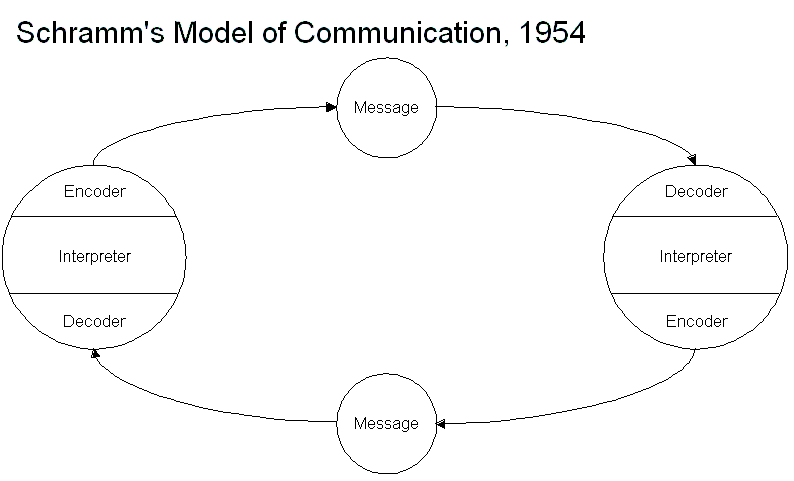 SMCR was created by Wilber Schramm in 1982 – he is often credited as the founder of mass communication studies. SMCR stands for Source-Message-Channel-Receiver. This can be applied to text messaging.
According to the model, the source is the originator of communication – in this case the phone. The message is the content of communication or in other words the information that is being exchanged. In this case it would be the text itself. The channel is the medial of transition system used to convey the message from one place to another. Examples of this include Verizon or AT&T. The receiver of this is the destination of the communication or the phone to which you were texting.
Other important terms to remember when it comes to texting are encoder, decoder, feedback and noise. Encoder translates the message into a form that can be communicated – often a form that cannot be interpreted by the human senses. This, when texting, flows through the air via satellites. A decoder reverses the encoding process. This turns the unreadable text back to font that can be passed on to the next phone. A feedback mechanism between the source and the receiver regulates the flow of communication. Noise is any distortion or errors that may be introduced during the information exchanges. This includes a dropped text – similar to a dropped call.
Clearly each of these terms are key to the use of text messaging.
Convergence in Media Industries
A convergence trend continues to propel the transformation of conventional media to digital forms . . . although the forces behind this trend are shifting (Media Now 7). The early 1990’s was a prime time for convergence. One prime example is the when Time Warner merged with AOL (America Online). At the time Time Warner was a publishing and cable television giant; AOL was the largest internet provider. Other convergences include the time News Corporation, the owner of Fox News, bought networking site MySpace.com. Former enemies in the media industry National Amusements (owner of Viacom cable networks and CBS), Disney Corporation and NBC Universal made, distributed and exhibited content across the internet; as well as by print, radio, recorded music, television and film.
Later on, new media companies took over. 
Charter Communications, one of the largest cable companies in the US, filed for bankruptcy. The owner of CBS television and Viacom, was for to sell video game maker Midway Games at a huge loss.
“Now, strategic sales of media properties are the centerpiece of corporate strategies” (Media Now 8).
Subscribe to:
Posts (Atom)